
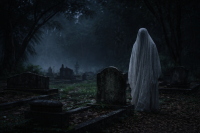
Name: Hantu Kubur
Location/Origin: Malaysia. Most commonly associated with rural villages and old cemeteries, especially burial grounds that are abandoned, poorly maintained, or disturbed.
Powers: Bound to a specific grave or burial site. Able to induce intense fear, disorientation, and spiritual unease. In some accounts, it can cause illness or lingering misfortune to those who disrespect burial grounds or death rituals.
Appearance: A human-shaped figure often wrapped in a burial shroud. Its features are indistinct or obscured, appearing as a shadow, silhouette, or pale form near a grave. Gender and facial details are usually unclear or absent.
Specific Danger: Hantu Kubur does not pursue victims. The danger comes from proximity. Lingering near graves at night, disturbing burial sites, or behaving disrespectfully in cemeteries is believed to draw its attention, leading to fear, illness, or becoming spiritually “lost.”
Evolution: Traditionally seen as a restless spirit formed through improper burial rites or unresolved matters in life. In modern folklore, Hantu Kubur is often interpreted as a manifestation of lingering spiritual energy tied to place rather than a conscious, roaming entity.
Stories of Hantu Kubur are whispered rather than told. It is said to appear only when the boundary between the living and the dead has been disturbed. In Malay folklore, a proper burial is not simply a formality. It is a necessary passage. When rites are rushed, ignored, or disrespected, the spirit of the deceased may fail to move on, remaining bound to the grave itself. Over time, that presence becomes Hantu Kubur. Unlike many spirits, it does not roam forests or stalk villages. It stays close to the earth that holds it. Witnesses describe seeing a solitary figure standing near a grave late at night, wrapped in a burial shroud, unmoving. Sometimes it appears seated, as if waiting. Sometimes it vanishes the moment it is noticed, leaving behind an overwhelming sense of dread.T hose who encounter Hantu Kubur rarely describe an attack. Instead, they speak of confusion, sudden fear, and a feeling of being watched long after leaving the cemetery. In some accounts, individuals who mocked graves or wandered burial grounds at night fell ill days later, unable to explain the cause. Hantu Kubur is not believed to seek revenge. It exists as a consequence, a presence born from neglect, disrespect, or unfinished spiritual passage.
Warning to Travelers:
Avoid graveyards after dark, especially old or neglected ones. Do not sit on graves, step over them, or disturb the earth in any way.Travelers are warned not to laugh loudly, shout, or behave casually in burial grounds. Even pointing at graves or taking photos carelessly is considered disrespectful in traditional belief.If you feel sudden fear, dizziness, or the sensation of being watched while near a grave, leave immediately without looking back. Do not run. Do not call out. Simply walk away.It is said that Hantu Kubur does not follow. But those who linger may carry something with them long after they leave.
Symbolism:
Hantu Kubur represents the cost of forgetting the dead. In Malay culture, death is not an end but a transition that requires care, respect, and ritual. Hantu Kubur embodies what happens when that transition is interrupted or ignored. It is a reminder that places of burial are not empty spaces but spiritual thresholds. Unlike violent or predatory spirits, Hantu Kubur enforces boundaries quietly. It does not punish through force, but through fear, unease, and lingering consequence. The spirit stands as a guardian of the grave, and a warning that some places should not be treated casually. To encounter Hantu Kubur is not to be attacked.
It is to be reminded that the dead are still present, and that respect is not optional.