
Name: Pontianak (also known as Kuntilanak in some regions)
Location/Origin: Malay folklore of Malaysia, Indonesia, and Singapore. Most often associated with rural areas, banana groves, village outskirts, and quiet roads at night.
Powers: Supernatural strength and speed, hypnotic presence used to lure victims closer, ability to appear as a beautiful woman from a distance, heightened senses in darkness, vampiric feeding on human victims.
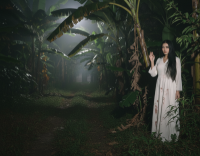
Appearance: Appears as a beautiful Malay woman wearing a long white dress, with long black hair
At close range, her true nature may reveal itself through unnatural eyes, distorted features, or a sudden predatory shift. She is frequently seen standing silently near trees or paths, beckoning rather than attacking
Specific Danger: Pontianak’s danger lies in temptation. Unlike the Langsuir, which attacks indiscriminately, Pontianak waits for her victim to approach her willingly, often disguising herself as a lost or vulnerable woman. Those who follow her are rarely seen again. her main victims are men who travel alone at night, or drawn to her by beauty and desire.
Evolution: Believed to originate from the spirit of a woman who died during childbirth. Over time, the legend evolved into a distinct archetype: a calculating hunter who relies on seduction and choice rather than rage. While closely related to the Langsuir in origin, Pontianak represents deliberate luring, not uncontrolled violence.
According to Malay folklore, the Pontianak is the restless spirit of a woman who died during childbirth, her death marked by pain, abandonment, or betrayal. Unlike spirits that wander aimlessly, the Pontianak is said to remain near the edges of human life — rural paths, banana groves, village outskirts — places where people pass through but do not linger. Travelers describe seeing a lone woman standing beneath the trees at night, dressed in white, her face calm and familiar. She does not chase. She does not cry out for help. She simply waits — and sometimes raises a hand, beckoning gently, as if inviting a small kindness.Those who approach her often realize too late that something is wrong. The air grows heavy. Sounds fade. The woman’s beauty fractures under close inspection, revealing something ancient and predatory beneath the surface. By the time fear takes hold, escape is said to be impossible.In many stories, the Pontianak leaves no trace of her victims. The road remains empty. The forest silent. Only rumors remain, passed from village to village as warnings.
Warning to Travelers:
If you encounter a woman standing alone at night in rural areas — especially near banana trees or forest paths — do not approach her, no matter how calm or familiar she appears.The Pontianak is believed to prey on curiosity, compassion, and desire. She relies on the victim’s choice to come closer, making her far more dangerous than spirits that attack outright. Locals warn against responding to calls, following gestures, or lingering too long in isolated areas after dark. If the night grows unnaturally quiet, or if a sense of unease settles without explanation, it is said to be best to turn back immediately.
Symbolism:
The Pontianak embodies fears surrounding temptation, vulnerability, and the unseen dangers of trust. Unlike spirits driven by rage, she represents the consequences of choice — the moment when instinct is ignored in favor of desire or misplaced empathy.Her legend also reflects deep cultural anxieties around childbirth, abandonment, and the fragile line between life and death. As a spirit born from maternal tragedy, she stands as both victim and predator — a reminder that unresolved suffering does not disappear quietly. In contrast to related spirits such as the Langsuir, the Pontianak symbolizes deliberate deception rather than uncontrolled grief, making her a warning not just against supernatural threats, but against the dangers of following what appears inviting in the dark.